The journey of motorcycles from the time of horse-drawn carts to the current era of replacing internal combustion engines (ICE) with battery packs is nothing short of fascinating. We’ve swapped the horsepower of a living, breathing creature with the horsepower generated by engines, and now, the roar of the engine is being replaced by the hum of electric motors. It’s a remarkable evolution, reflecting not just advancements in technology but also a shift towards more sustainable and eco-friendly transportation.
What is an EV Drivetrain?
An electric vehicle (EV) drivetrain is a system that converts electrical energy from the battery pack into mechanical energy to drive the wheels.
What Makes Up an EV Drivetrain?
- Electric motor: The electric motor is the heart of the EV drivetrain. It converts electrical energy into mechanical energy, which is then used to turn the wheels.
- Battery pack: The battery pack stores the electrical energy that powers the electric motor.
- Power electronics: The power electronics control the flow of electricity from the battery pack to the electric motor. They also convert the direct current (DC) electricity from the battery pack into the alternating current (AC) electricity that the electric motor needs.
- Transmission: The transmission (or gearbox) transfers the mechanical energy from the electric motor to the wheels. It is also used to control the speed of the vehicle.
- Driveshaft: The driveshaft transfers the mechanical energy from the transmission to the wheels.
Transformative Advantages of Electric Vehicle Drivetrains
Electric vehicle (EV) drivetrains have several advantages over internal combustion engines, including:
1. Efficiency
EV drivetrains are very efficient, converting up to 90% of the electrical energy from the battery pack into mechanical energy. This is much more efficient than internal combustion engines, which typically convert only 20–30% of the chemical energy in gasoline into mechanical energy.
2. Performance
EV drivetrains can provide instant torque, which gives electric vehicles excellent acceleration. They are also very quiet and smooth to operate.
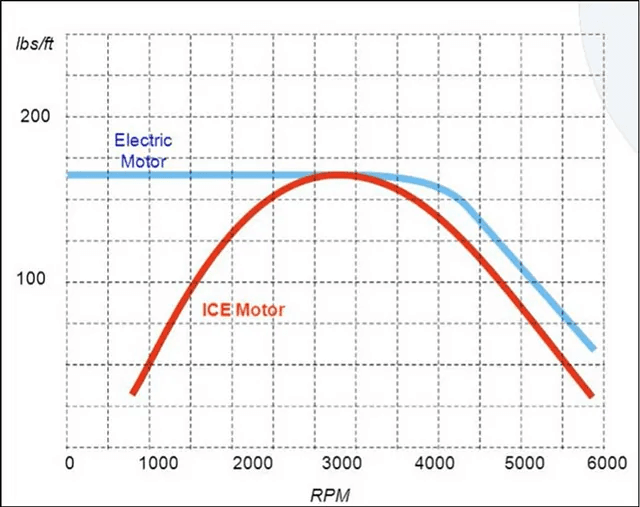
Electric motors exhibit the capability to deliver maximum torque consistently from 0 rpm, maintaining this high torque output across a broad range of rpm. This characteristic enhances traction force significantly, offering a heightened sense of driving pleasure in electric vehicles. In contrast, internal combustion engines, such as those powered by gasoline or diesel, experience a gradual increase in torque from idle speed, reaching a peak only in the mid-rpm range before subsequently diminishing.
3. Reduced maintenance
EV drivetrains have fewer moving parts than internal combustion engines, which means that they require less maintenance. This can be a major advantage for motorcycle owners who want to spend less time in the garage and more time on the road.
4. New design possibilities
EV drivetrains open up new design possibilities for motorcycles. For example, since there is no need for a gas tank, motorcycle designers can be more creative with the shape and layout of the motorcycle . For example, EV drivetrains can help to improve the handling and stability of a motorcycle by lowering the center of gravity and improving the weight distribution.
5. More affordable motorcycles
As EV technology becomes more mature and affordable, we can expect to see more affordable electric motorcycles on the market. This will make electric motorcycles more accessible to a wider range of riders.
6. Zero Emissions
EV drivetrains do not produce any tailpipe emissions, which makes them much better for the environment than internal combustion engines.
Understanding Varied EV Drivetrains
High-voltage drivetrains operate at voltages above 60 volts. They are typically used in EVs with larger battery packs and more powerful electric motors. High-voltage drive trains offer better performance and range than low-voltage drive trains, but they are also more complex and expensive.
Low-voltage drivetrains operate at voltages below 60 volts. They are typically used in EVs with smaller battery packs and less powerful electric motors. Low-voltage drive trains are simpler and less expensive than high-voltage drive trains, but they offer less performance and range.
Choosing the Perfect Voltage for Your Drivetrain
Selecting the right voltage for your drivetrain is a crucial decision, and it all boils down to understanding your vehicle’s power needs. The key approach involves evenly distributing voltage and current, minimizing heat losses, and establishing a secure system with robust electromagnetic compatibility. So, how do you navigate the intricacies of choosing the ideal voltage for your drivetrain? Let’s dive in and explore the nuances of this critical decision.
Effect of Voltage on Drive System
India is the largest two-wheeler market in the world, and a significant chunk of two-wheelers sold in India have a power output greater than 10 kW. This is a market that is very specific to India, so there is a necessity to develop an indigenous sub-component ecosystem for our specific requirements.
One of the challenges in developing electric two-wheelers for the Indian market is the need for higher power output. The electrical power output of a battery is a product of the voltage and current. To pull higher power out of the battery, we either need to increase the voltage or current. The voltage of the electric system will fairly be a constant value throughout the drive condition, but the current keeps changing as per the speed and acceleration of the motorcycle.
This means that Indian electric two-wheelers need to have battery packs and electric motors that are capable of handling higher currents. This is a challenge because high-current components are typically more expensive and complex to manufacture.
However, it is important to develop an indigenous sub-component ecosystem for Indian electric two-wheelers in order to make them more affordable and accessible to consumers. This will also help to create jobs and boost the Indian economy.
What Does High Voltage Mean in Industrial Terms?
According to AIS 156, a high voltage system is classified as an electric component or circuit with a working voltage greater than 60 V and less than or equal to 1500 V DC.
One of the main advantages of high voltage systems is that they are more efficient than low voltage systems. This is because high voltage systems have lower current losses. Lower current losses also mean less heat generation, which improves the durability of high voltage systems. Another advantage of high voltage systems is that they can transmit more power over longer distances than low voltage systems. This is because high voltage systems have lower voltage drop.
Link
Why did Raptee.HV Choose High Voltage Drivetrain?
Since the inception of Raptee.HV, our mission has been clear: to engineer a motorcycle that stands toe-to-toe with the established 250–300cc bikes in the Indian market. Achieving a power output exceeding 20 kW became our non-negotiable goal, necessitating the adoption of a high-voltage system to propel us into the realm of superior performance.
Conclusion
The choice of whether to use a high voltage or low voltage EV drivetrain depends on a number of factors, including the desired performance, cost, and safety. In general, high voltage systems are the future of EV drivetrains as they offer better performance and efficiency. As EV technology continues to develop, the cost and complexity of high voltage systems will decrease, making them more accessible to all consumers.